







OM4 vs OS2 Fiber: Which Is Better for 400G and 800G Networks?
2026-10-29
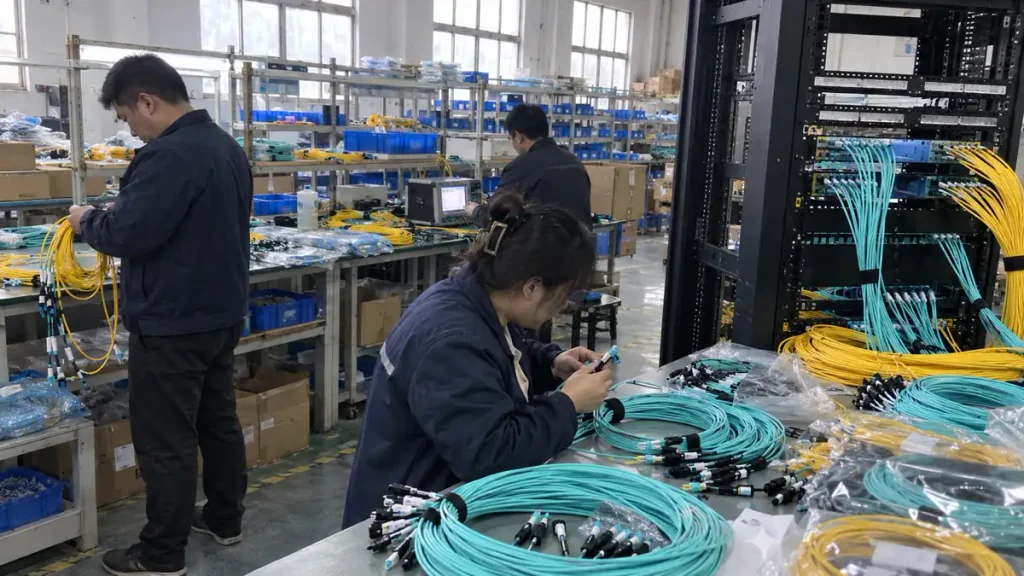
For 400G and 800G data center cabling, the choice between OM4 multimode fiber and OS2 single-mode fiber should not be made only by cable price. The correct choice depends on link distance, optical module type, connector format, cabinet layout, future upgrade plan and installation method.
In short-distance equipment areas, OM4 still has value because it can work well with suitable short-reach multimode modules and high-density MPO/MTP cabling. For longer routes, inter-room links, backbone cabling and future 800G expansion, OS2 is usually the safer long-term choice.
At SOCT Fiber, we normally review the project link table before recommending fiber optic cable, indoor fiber optic cable, MTP/MPO fiber cable, fiber optic patch cord and pre-terminated cable assemblies for data center projects.
Why OM4 vs OS2 Becomes More Important at 400G and 800G
At 10G, 25G or even 100G, many projects could choose fiber type by a simple distance rule. At 400G and 800G, the decision becomes more sensitive because optical modules and connector structures directly affect the cabling design.
For example, 400G SR8 or other short-reach multimode modules may use OM4 in short data hall links. 400G DR4, FR4 and many longer-reach single-mode modules normally require OS2. For 800G, the module choice becomes even more important because the project may involve MPO/MTP, LC, breakout links, parallel optics or future migration from existing 400G ports.
This is why we do not suggest choosing OM4 or OS2 only from a product name. The fiber type must match the real link design.
OM4 vs OS2 for 400G/800G Data Center Cabling
| Item | OM4 Multimode Fiber | OS2 Single-Mode Fiber |
|---|---|---|
| Best use | Short links inside the data hall | Longer links, backbone routes and future expansion |
| Common project area | Cabinet-to-cabinet, row-level cabling, short switch links | MMR links, inter-room routes, campus or building-to-building cabling |
| 400G module match | Commonly used with short-reach multimode options such as SR-type modules | Commonly used with DR, FR and longer-reach single-mode modules |
| 800G upgrade flexibility | Good only when future distance and module type are clearly limited | Usually stronger for long-term 800G upgrade planning |
| Connector format | Often MPO/MTP or LC depending on module and breakout design | Often LC, MPO/MTP or pre-terminated trunk configuration |
| Main risk | Future distance or module change may require re-cabling | Initial module cost may be higher in some short-link cases |
| Selection advice | Use for confirmed short links where module cost control matters | Use for backbone, uncertain distance and long-term upgrade routes |
Choose by Link Scenario, Not by Fiber Name Only
A practical 400G/800G cabling design often uses different fiber types in different parts of the data center. The key is to divide the project into link scenarios before ordering cable.
| Link Scenario | Recommended Direction | Reason |
|---|---|---|
| Server cabinet to nearby switch | OM4 can be suitable | Distance is usually short and high-density cabling is important |
| Switch to spine inside the same data hall | OM4 or OS2, depending on module and distance | Both can work, but the module type must be confirmed first |
| Data hall to MMR or cross-connect room | OS2 is usually safer | The route may become part of the long-term backbone |
| Building-to-building or campus link | OS2 | Longer distance and future upgrade requirements are more likely |
| New 400G project with future 800G plan | OS2 for backbone, OM4 only for confirmed short links | This reduces the risk of replacing cable during the next upgrade |
When OM4 Is Still a Good Choice
OM4 is still useful in 400G/800G data center cabling when the link is short, the optical module is already confirmed and the equipment layout is stable. It is especially practical for high-density internal cabling where the project wants to control short-reach module cost.
OM4 is suitable when:
- The link distance is short and clearly confirmed.
- The connection is mainly inside one data hall.
- The selected 400G or 800G module supports OM4 at the required distance.
- The project uses high-density MPO/MTP trunk cable or short patching links.
- The layout is unlikely to become a long-distance backbone route later.
For these applications, SOCT Fiber can supply OM4 MTP/MPO trunk cables, OM4 patch cords, breakout cables, indoor LSZH cable and labeled pre-terminated assemblies according to rack layout and port configuration.
When OS2 Is the Better Long-Term Choice
OS2 single-mode fiber is usually recommended when the link distance is longer, the project involves different rooms or buildings, or the customer wants a clearer upgrade path from 400G to 800G. OS2 is also the better option when the optical modules are DR, FR, LR or other single-mode types.
OS2 is usually more suitable when:
- The project includes inter-room, inter-building or campus routes.
- The future link distance may change during expansion.
- The cabling route will serve as a backbone path.
- The project needs stronger 800G upgrade flexibility.
- The optical module specification requires single-mode fiber.
For these projects, SOCT Fiber can provide OS2 indoor cable, OS2 trunk cable, pre-terminated LC or MPO/MTP assemblies, patch cords, patch panels and related fiber management products.
Do Not Compare OM4 and OS2 by Cable Price Alone
In many projects, the wrong selection happens because the comparison starts from cable unit price. For 400G/800G data center cabling, the real cost is the complete link cost.
A proper comparison should include:
- Optical module type and cost
- Link distance and loss budget
- MPO/MTP or LC connector structure
- Fiber count and spare fiber plan
- Patch panel and cable management design
- Installation labor and testing cost
- Risk of replacing cable during the 800G upgrade
OM4 may reduce cost in short-reach areas if the module type supports the distance. However, if that same route later needs longer transmission or a different 800G module, the project may face re-cabling. OS2 may require a higher initial module budget in some short-link cases, but it can reduce long-term upgrade risk for backbone and expansion routes.
How to Avoid Re-Cabling During a 400G to 800G Upgrade
The safest method is to separate short equipment links from long-term backbone links during the first design stage.
For short, fixed cabinet links, OM4 can remain a reasonable choice if the module roadmap is clear. For backbone, MMR, campus and uncertain expansion routes, OS2 should be considered from the beginning. This approach avoids using one fiber type for every route and reduces the chance of replacing cable later.
Connector planning is also important. MPO/MTP polarity, fiber count, breakout structure, LC interface and insertion loss must be checked before ordering pre-terminated cable. If the cable length, polarity or connector format is wrong, the installation team may not be able to correct it easily on site.
Recommended Cabling Approach for 400G/800G Projects
For most new data center projects, we suggest the following selection logic:
- Use OM4 only where the link distance, optical module and future use are already clear.
- Use OS2 for backbone, MMR, inter-room and campus routes.
- Confirm the optical module type before confirming the connector format.
- Use pre-terminated MTP/MPO trunk cable where fast installation and clean cable management are required.
- Reserve spare fibers for future port expansion.
- Check insertion loss and polarity before mass production.
This is more reliable than asking whether OM4 or OS2 is “better” in general. The better choice is the one that matches the link distance, module type and upgrade path.
What SOCT Fiber Needs Before Quotation
To provide an accurate quotation for 400G/800G data center cabling, please send the project information as clearly as possible. A simple link table is enough for the first review.
| RFQ Item | Example Information to Provide |
|---|---|
| Port speed | 400G, 800G, or mixed 100G/400G/800G |
| Link distance | Rack-to-rack, row-to-row, room-to-room, building-to-building |
| Module type | SR, DR, FR, LR, breakout module, or switch model if known |
| Fiber type | OM4, OS2, or need recommendation |
| Connector type | MPO/MTP, LC, breakout cable, trunk cable |
| Fiber count | 12F, 24F, 48F, 72F, 96F or project-specific count |
| Cable jacket | LSZH, PVC, flame-retardant or other indoor requirement |
| Installation method | Pre-terminated cable, patch panel, cable tray or cabinet routing |
| Project documents | Rack layout, link schedule, cable list or drawing |
If the module type is not confirmed yet, you can still send the link distance and rack layout. We can help check whether OM4 or OS2 is more suitable for each route.
FAQ: OM4 vs OS2 for 400G/800G Data Center Cabling
Is OM4 suitable for 400G data center cabling?
Yes. OM4 can be suitable for short 400G links inside a data hall when the selected multimode optical module supports the required distance.
Is OS2 better for 800G data center cabling?
OS2 is usually better for 800G backbone, long-distance and future expansion links because it supports more single-mode module options and longer transmission distances.
Can OM4 and OS2 be used in the same data center?
Yes. Many projects use OM4 for short internal links and OS2 for backbone, MMR, inter-room or campus links.
Should I choose OM4 or OS2 if I plan to upgrade from 400G to 800G?
If the link is short and the future module type is clear, OM4 may still work. If the link may become longer or part of a backbone route, OS2 is the safer choice.
Does OS2 always cost more than OM4?
No. OS2 modules may cost more in some short-link cases, but OS2 can reduce future re-cabling risk. The full cost should include modules, cable, installation, testing and future upgrade requirements.
Is MPO/MTP required for 400G and 800G cabling?
Not always. MPO/MTP is common in high-density and parallel optic cabling, but LC is still used in many single-mode and breakout applications. The module interface should be checked first.
What is the biggest mistake when selecting OM4 or OS2?
The biggest mistake is choosing by cable price only. The correct selection must consider distance, module type, connector format, loss budget and future upgrade plans.
Final Recommendation
If the link is short, inside the same data hall and the optical module is already confirmed, OM4 can still be a practical choice for 400G/800G data center cabling. If the route is longer, connects different rooms or buildings, or must support future 800G expansion with fewer changes, OS2 is usually the safer long-term option.
For a reliable quotation, please send the link distance, port speed, module type, fiber count, connector type, rack layout and project drawing if available. SOCT Fiber can help confirm whether OM4, OS2 or a mixed cabling plan is more suitable for your 400G/800G data center project.
