

Hollow-core fiber (HCF) is a type of optical fiber with a hollow interior, representing a paradigm shift from traditional fiber designs. Unlike conventional fibers that guide light via total internal reflection in glass, hollow-core fibers confine light to a central air (or vacuum) channel primarily through the photonic bandgap effect or the anti-resonant effect.
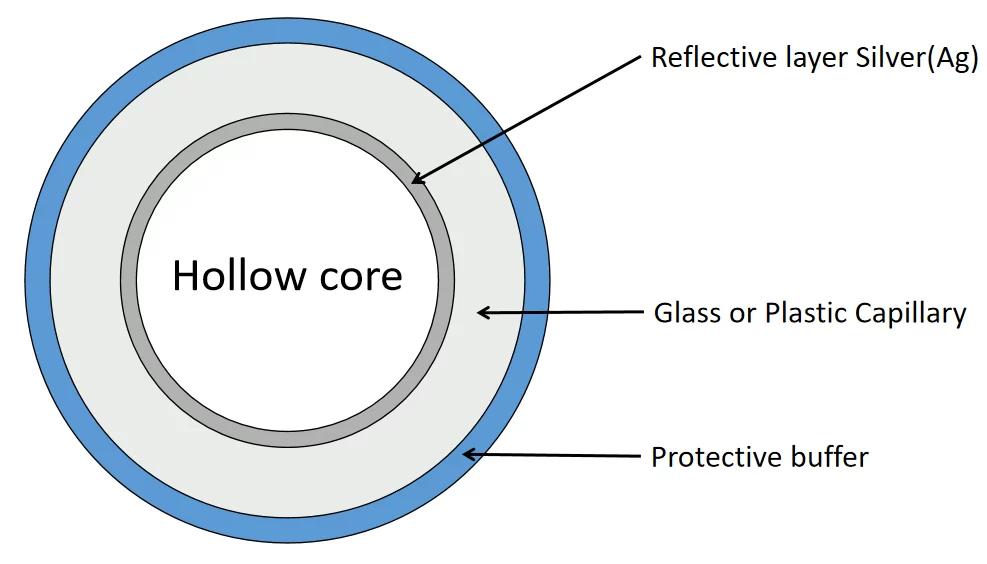
1. Core Principles: How Does Light Travel in a “Hollow” Pipe?
Traditional optical fibers are “solid” and use the principle of total internal reflection: a high-refractive-index core continuously reflects and confines light, guiding it forward.
Hollow-core fibers, however, are fundamentally different, relying on two main physical mechanisms:
Photonic Bandgap Effect: The fiber’s cladding consists of a meticulously designed microstructure (such as a periodic arrangement of air holes). This structure creates a specific photonic bandgap, similar to the electronic bandgap in semiconductors. Light within this bandgap’s frequency range cannot propagate through the cladding material, forcing it to be “trapped” and guided forward within the central air core.
Anti-Resonant Effect: The more prevalent type is the anti-resonant hollow-core fiber, also known as anti-resonant guiding fiber. Its cladding is made up of a ring of thin-walled glass capillaries. When light attempts to leak from the air core into the glass capillary walls, it is reflected at the two interfaces of the glass wall. By precisely designing the thickness of the glass wall, these reflections are made to undergo constructive interference (anti-resonance), which dramatically enhances the light’s confinement and effectively traps it within the air core.
Key Difference: In traditional fibers, light travels mainly through glass; in hollow-core fibers, light travels primarily through air.
2. Comparison with Conventional Solid-Core Fibers (Advantages and Disadvantages)
| Characteristic | Hollow-Core Fiber | Traditional Solid-Core Fiber |
| Transmission Medium | Air/Vacuum (>95% of optical power) | Solid glass |
| Transmission Speed | Faster (air’s refractive index is ~1, close to the speed of light, c) | Slightly slower (glass’s refractive index is ~1.47, speed is c/1.47) |
| Attenuation/Loss | Theoretically lower, but currently higher in practice (especially in communication bands). Has achieved lower loss than traditional fiber at specific wavelengths (e.g., mid-infrared). | Extremely low (~0.17 dB/km) in the 1550 nm window; the technology is very mature. |
| Nonlinear Effects | Extremely low (light interacts very weakly with air) | Relatively high (light interacts strongly with the dense glass medium) |
| Damage Threshold | Extremely high (energy is distributed in air, less prone to burn-out) | Lower (energy is concentrated in a small glass area, prone to thermal effects and damage) |
3. Key Application Areas
The unique advantages of hollow-core fibers make them irreplaceable in certain fields:
High-Performance Communications:
Low-Latency Trading: In high-frequency financial trading, a few microseconds of delay are critical. The speed advantage of hollow-core fiber (approx. 31% faster than traditional fiber) can provide a significant time advantage.
Future Communication Systems: Their low nonlinearity can suppress crosstalk between channels, making them promising for next-generation, high-capacity, long-distance communication systems.
High-Power Laser Transmission:
This is currently the most mature and commercialized application. Used in laser processing (cutting, welding), medical devices (surgical lasers), and defense (laser weapons). Traditional fibers often fail when transmitting high-power lasers due to nonlinear effects and thermal damage, a problem that hollow-core fibers perfectly solve.
Gas Sensing and Nonlinear Optics:
The hollow core can be filled with a gas to be measured. The extremely long interaction distance between light and gas allows for very high sensitivity.
Used in cutting-edge scientific research to generate new laser frequencies and study light-matter interactions.
Quantum Communications:
Photons traveling in air interact minimally with the environment, better preserving their quantum state. This makes HCFs an ideal medium for quantum information transmission.
4. Current Challenges and Future Outlook
Challenges:
Loss: Although continuously being reduced, the loss in the most common communication band (1550 nm) is still higher than that of traditional fibers, which is the biggest obstacle to replacing conventional communication fibers.
Manufacturing Difficulty and Cost: The complex microstructure designs require highly precise manufacturing processes, making production expensive.
Reliability: Mechanical strength, bending performance, and environmental stability still need further improvement.
Outlook:
Hollow-core fiber represents a revolutionary leap in fiber technology. While challenges remain, it is rapidly transitioning from a laboratory concept to practical applications in specific fields. As manufacturing technology advances and costs decrease, it is expected to play an increasingly vital role in ultra-fast lasers, quantum technology, sensing, and next-generation communications, becoming a key component of future optical infrastructure.
In summary, hollow-core fiber is not intended to completely replace traditional fiber but rather to open up a new technological path. It solves bottlenecks that traditional fibers cannot overcome under extreme performance demands, opening new doors for optical applications.