

1. Product Description
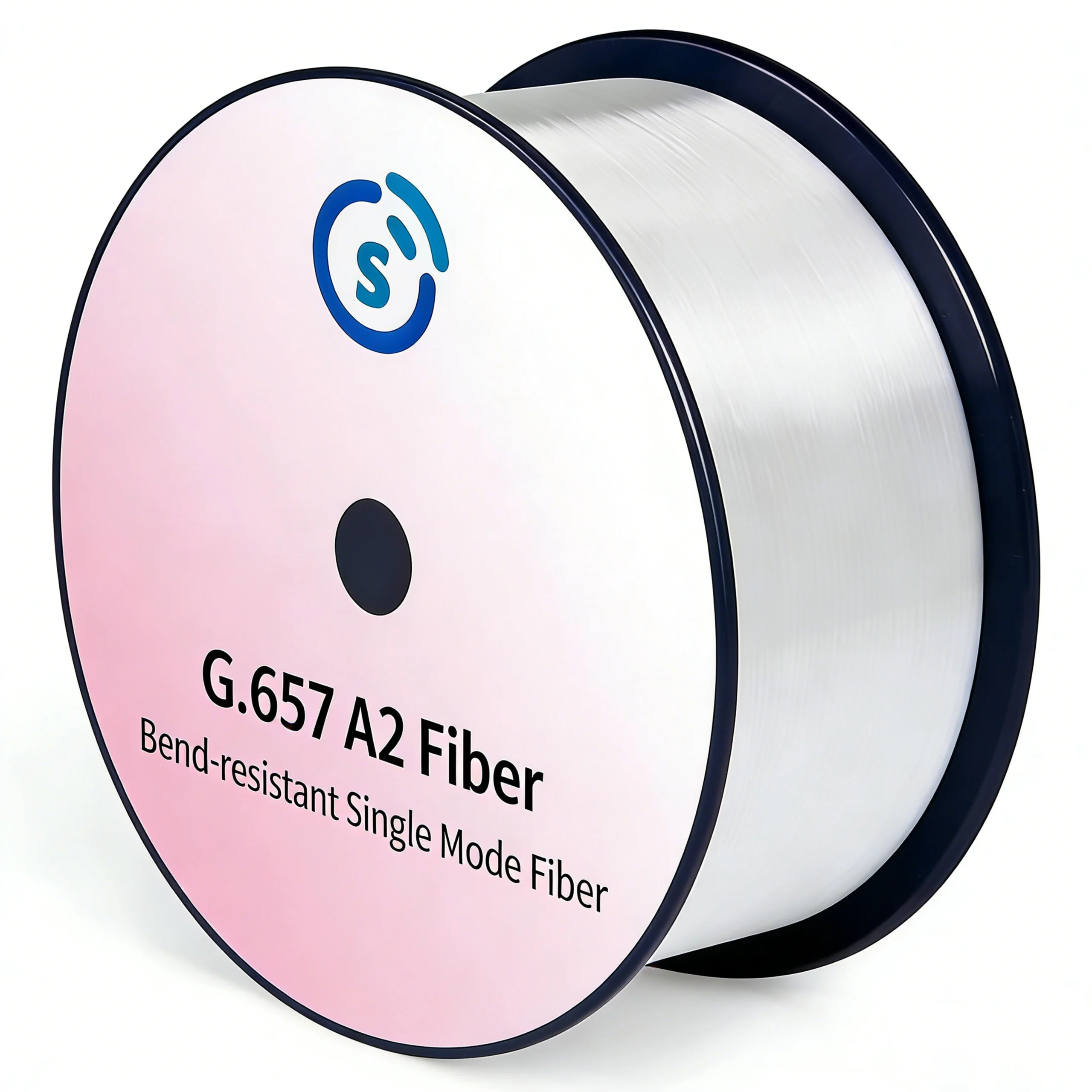
SoctFiber HD A2 200 is an ultra-low bend-loss optical fiber compliant with ITU-T G.657.A2, with a diameter of 200 microns.
This fiber supports the production of small-diameter, ultra-high-density (HD) optical cables, helping operators maximize the number of fibers deployed in existing duct systems. It can also reduce the size of new ducts and even eliminate the need for additional ducts and related infrastructure.
In addition, the induced loss of this fiber under extreme bending conditions is only half of the requirement specified in the ITU-T G.657.A2 standard, which effectively improves installation and operation efficiency in high-density network environments.
Its ultra-low bend-loss performance covers the longer wavelengths required for future network system upgrades. High-density fiber technology integrated with ultra-low bend-loss characteristics helps operators optimize physical asset utilization and ensure their high-density networks are future-proof.
The demand to deploy more fibers in limited space has driven the wide application of bend-insensitive fibers and reduced-diameter fibers.
SoctFiber HD A2 200 is particularly suitable for network applications requiring ultra-high-density cables and supporting components.
SoctFiber’s fiber-optic solution is specially designed to support combat missions in areas with extremely intensive enemy electronic warfare (EW) and electronic intelligence (ELINT) activities.
Its main application scenarios are strike FPV drones and reconnaissance platforms, where the use of radio links is either unfeasible or poses significant risks to operators.
This solution enables UAV units to:
- Operate under radio silence to avoid exposing the operator’s position through radio transmission.
- Strike targets protected by powerful EW domes that jam standard frequency bands such as 433/915 MHz and 1.2/2.4/5.8 GHz.
- Fly in complex terrains such as ravines and urban areas where line-of-sight radio communication is unavailable, with fiber optics ensuring stable connection regardless of obstacles.
2. Product Benefits
- Maximizes fiber deployment capacity in existing infrastructure – enabling more than twice the number of fibers within the same cable diameter.
- Minimizes space occupation in ducts and supporting infrastructure – reducing cable cross-sectional area by up to 30% for the same fiber count.
- Improves installation and operation efficiency, and supports the use of compact closures and accessories – all thanks to its ultra-low bend-loss characteristics.
- Supports future system upgrades – its low bend-loss performance covers the longer wavelengths required for future system upgrades.
- Compatible with legacy networks – enables low-loss splicing with G.652.D and G.657.A1 fibers for seamless integration with existing systems.
3. Technical Specifications and Key Features
3.1 Key Features of G.657.A2 Fiber
Adopting the G.657.A2 standard provides a core engineering advantage.
Unlike conventional optical fibers, this type of fiber offers stronger resistance to micro-bending and a smaller critical bending radius.
This is particularly important in high-speed drone deployment scenarios, where cables may come into contact with tree branches or structural components.
- Ultra-low attenuation: The optimized structure enables signal transmission up to 25 km without repeaters, ensuring the highest quality for digital or analog video streams.
- High tensile strength: Despite an ultra-thin design for weight reduction, the fiber is equipped with a specialized protective coating that can withstand dynamic loads during aggressive drone maneuvers.
- Compact design: The fiber is supplied on specialized spools integrated into the deployment or mounting system of RMD-series drones, ensuring smooth and tangle-free payout.
3.2 Advantages Over Other Solutions
The core advantage of SoctFiber’s fiber-optic solution is guaranteed stable communication connectivity even when firmware adjustments or frequency hopping technologies fail.
Compared with traditional FPV systems based on ELRS or Crossfire, fiber-optic links cannot be intercepted or jammed remotely.
As the power of enemy jammers increases, fiber-optic drones remain unaffected, since signals are transmitted as light pulses inside the glass core.
Free from radio interference (commonly known as screen “snow”), operators can observe targets with maximum clarity, even when approaching EW emission sources at close range.
- Long-distance operation without repeaters: Normally, on-board repeaters are required for distances exceeding 20 km. Fiber optics enable direct operation at such ranges, simplifying mission preparation and reducing the number of deployed platforms.
| Optical Parameters | ||
| Attenuation Max. (dB/km) | ||
| 1310 nm | ≤ 0.35 | |
| 1383 nm | ||
| 1550 nm | ≤ 0.21 | |
| 1625 nm | ≤ 0.23 | |
| Macro bend loss (dB) | ||
| 1 turn 7.5 mm radius | 1550nm | ≤ 0.2 |
| 1 turn 10 mm radius | ≤ 0.1 | |
| 10 turns 15 mm radius | ≤ 0.03 | |
| 1 turn 7.5 mm radius | 1625nm | ≤ 0.5 |
| 1 turn 10 mm radius | ≤ 0.2 | |
| 10 turns 15 mm radius | ≤ 0.1 | |
| Mode Field Diameter (µm) at 1310 nm | 8.6 ± 0.4 | |
| Mode Field Diameter (µm) at 1550 nm | 9.6 ± 0.5 | |
| Cable cut-off wavelength (nm) | ≤ 1260 | |
| Zero dispersion wavelength (nm) | 1300 to 1324 | |
| Dispersion at 1550nm (ps/nm.km) | ≤ 18 | |
| Zero Dispersion Slope (ps/nm².km) | ≤ 0.092 | |
| PMD LDV (ps/√ km) | ≤ 0.06 | |
| Individual Fibre PMD* (ps/√ km) * Individual PMD values may change when cabled | ≤ 0.1 | |
| Point of discontinuities 1310nm & 1550nm (dB) | ≤ 0.05 | |
| Geometrical features | ||
| Cladding Diameter (μm) | 125 ± 0.7 | |
| Cladding Non-circularity (%) | ≤ 0.8 | |
| Core Clad Concentricity error (μm) | ≤ 0.5 | |
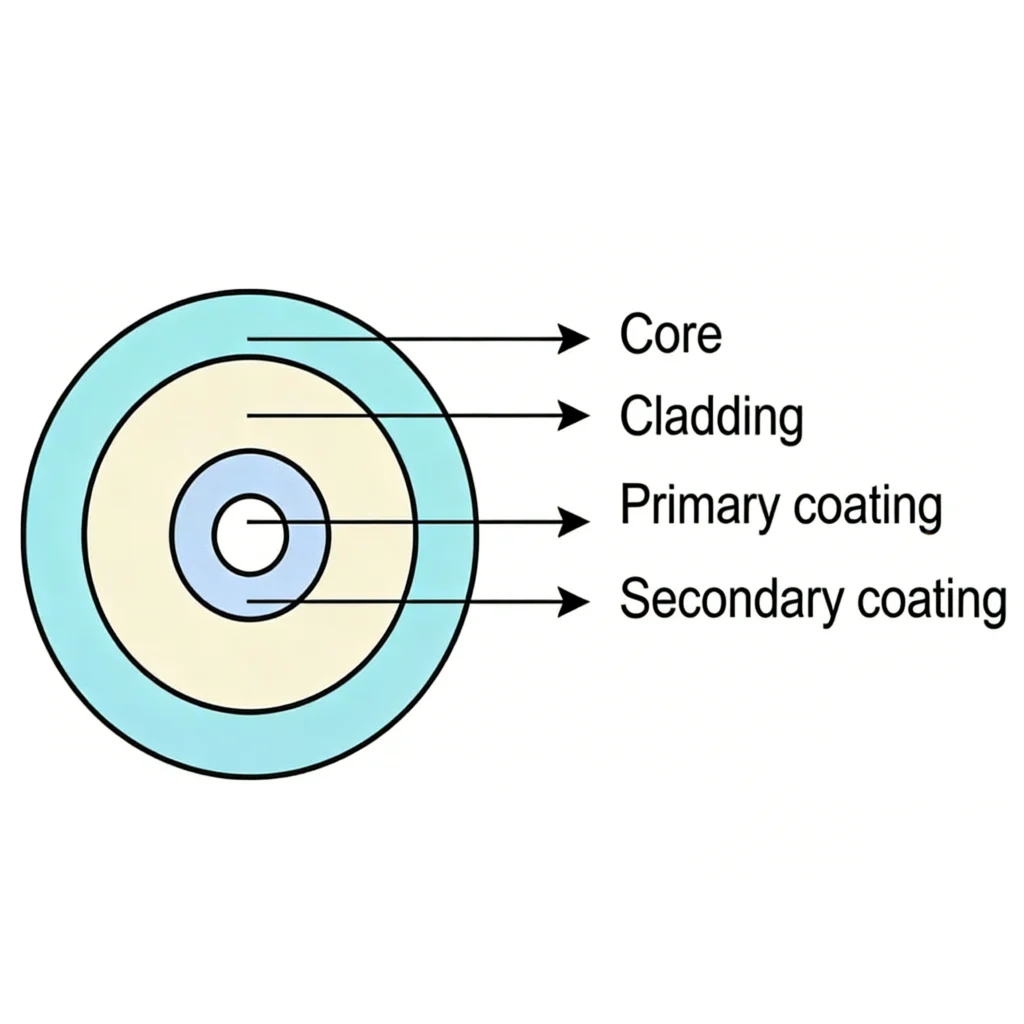
| Coating Diameter (uncoloured) (μm) | 190 ± 10 | |
| Coating Cladding Concentricity error (μm) | ≤ 10 | |
| Mechanical & Environmental Characteristics | ||
| Temperature dependence | -60°C to +85°C | ≤ 0.03 |
| Temperature humidity cycling | -10°C to +85°C, 95% RH | ≤ 0.05 (Induced Attenuation at 1310, 1550, 1625 nm (dB/km) |
| Water Immersion | 30 days, 23 ± 2°C | |
| High temperature and humidity aging | 30 days 85 ± 2°C, 85% RH | |
| Accelerated Aging (Temperature) | 30 days, 85 ± 2°C | |
| Proof Testing | ≥ 125 (kpsi) (0.86GN/m²) (This is equivalent to 1.2% strain) | |
| Fibre Curl (m) | ≥ 4 | |
| Performance Characteristics | ||
| Coating strip force | ≥ 1.0 N (0.2 lbf) and ≤ 5.0 N (1.1 lbf) | |
| Dynamic fatigue parameter (Nd) | ≥ 20 | |
| Effective group index of refraction (Typical Values) | 1.4678 at 1310 nm 1.4685 at 1550 nm 1.4689 at 1625 nm | |
| Attenuation in the wavelength region from 1285 – 1330 nm in reference to the attenuation at 1310 nm (dB/km) | ≤ 0.03 | |
| Attenuation increase in the wavelength region from 1525 – 1575 nm in reference to the attenuation at 1550 nm (dB/km) | ≤ 0.02 | |
4. G.657.A2 Single Mode Fiber Packing
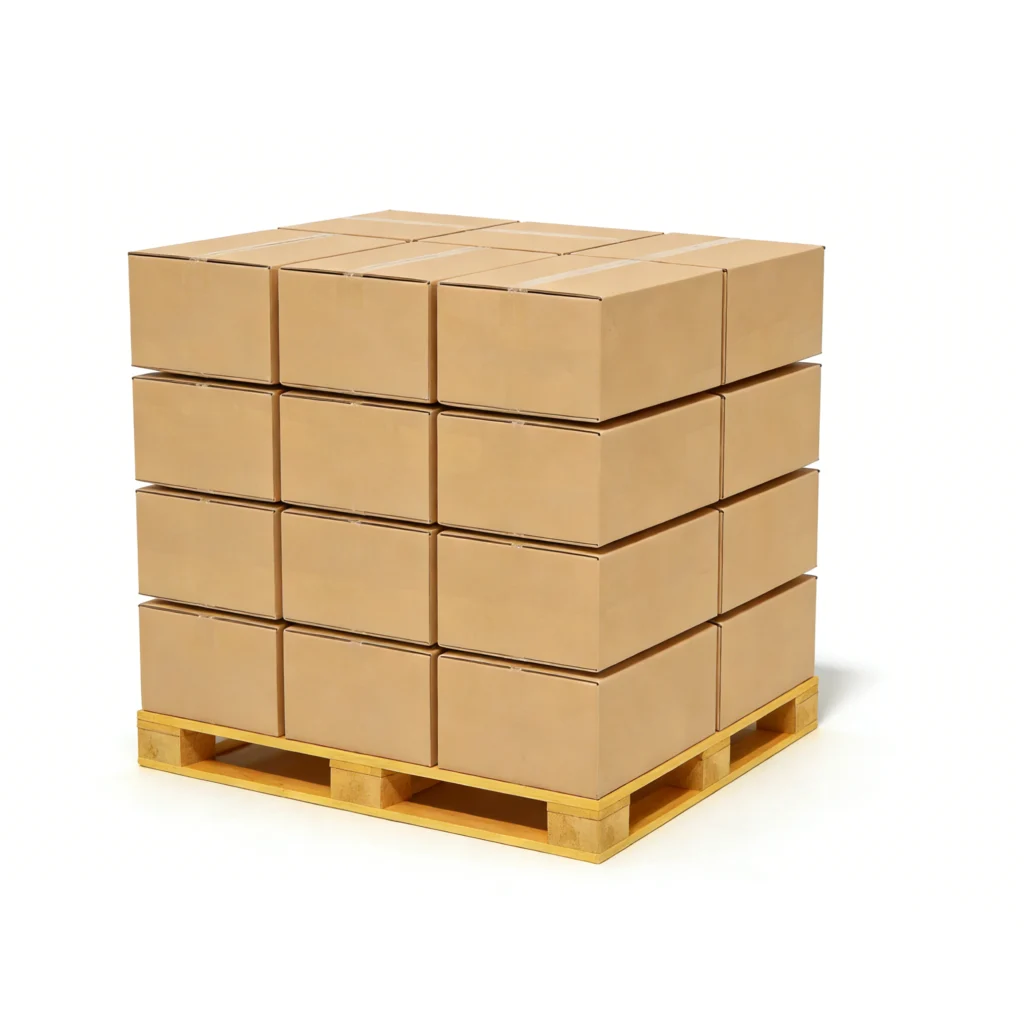
- Packaging can be customized to meet customer requirements.