

Designing aerial fiber routes over long distances is never just about bandwidth. Span length, mechanical safety, installation efficiency, and long-term reliability all directly affect project cost and risk.
For power corridors, rural backbones, river crossings, and hard-to-access terrain, 48-core long-span ADSS fiber optic cable with double HDPE jacket has become a proven solution. This article explains where it fits, why it works, and how to specify it correctly.
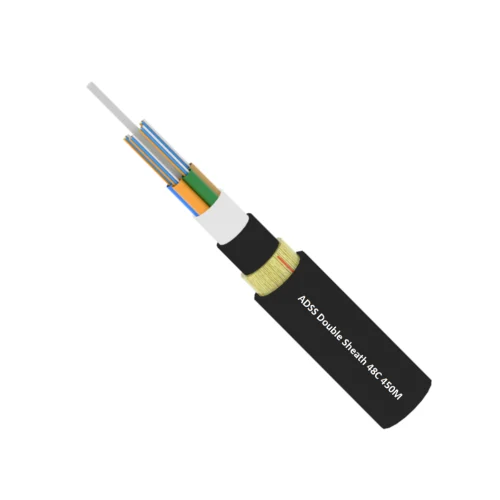
What Is Long-Span ADSS Fiber Optic Cable?
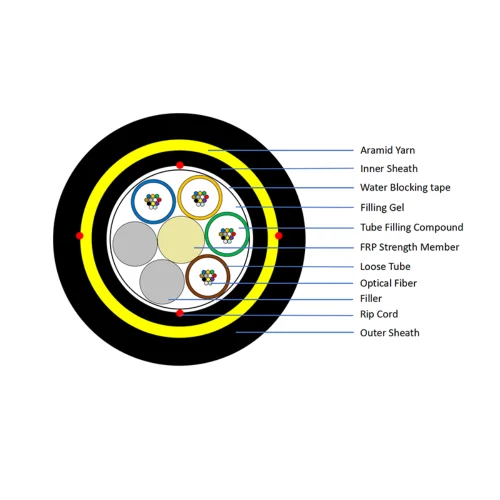
ADSS (All-Dielectric Self-Supporting) fiber optic cable is designed for aerial installation without a messenger wire. Its fully dielectric structure eliminates electrical conductivity and allows safe deployment in environments where metallic cables are not preferred.
A 450m long-span ADSS cable is engineered to maintain controlled sag and tensile stress over extended distances between support points, making it suitable for routes where adding poles or towers is difficult or expensive.
Why Choose a 48-Core, 450m, Double HDPE Design?
1. Balanced fiber capacity for backbone growth
A 48-fiber configuration supports backbone and aggregation networks while leaving reserve fibers for future expansion, redundancy, or additional services—without rebuilding the route.
2. Long-span capability reduces infrastructure dependency
With a design span of up to 450 meters, this cable minimizes:
- the number of poles or towers
- mid-span hardware and joints
- installation time in complex terrain
This is especially valuable in mountainous, rural, or wide-crossing environments.
3. Double HDPE jacket for demanding outdoor conditions
The double HDPE jacket structure improves resistance to:
- UV exposure
- abrasion and mechanical impact
- moisture, heat, and long-term aging
It is commonly selected for projects that require stable performance over decades, not just initial deployment.
Typical Applications
This cable configuration is widely used in:
- Power transmission and distribution communication lines
- Rural and remote broadband backbone networks
- Industrial monitoring and SCADA communication routes
- Inter-site and aggregation aerial links
- Long-span crossings over valleys, rivers, highways, or railways
Key Design Considerations Before Procurement
To ensure long-term performance, the following parameters should be confirmed at the design stage:
- Maximum span length and pole spacing
- Wind and ice load conditions
- Installation tension and sag requirements
- Fiber type and attenuation targets
- Route environment (temperature, UV, humidity, terrain)
Long-span ADSS performance is achieved through proper mechanical design, not fiber count alone.
How Long-Span ADSS Helps Control Total Project Cost
While long-span ADSS may have higher mechanical specifications, it often reduces overall project cost by:
- decreasing the number of support structures
- shortening installation time
- simplifying route planning in difficult areas
- lowering long-term maintenance and outage risk
For most projects, cost per reliable kilometer over service life is a more meaningful metric than cable unit price.
How to Get the Right Configuration and Quote
For an accurate recommendation and quotation, it is important to share:
- required span length (up to 450m)
- route environment and load conditions
- fiber type and quantity
- total route length and delivery location
- applicable project or utility standards
Providing this information allows the cable to be correctly engineered rather than over- or under-specified.
Frequently Asked Questions (FAQ)
1. Is 450m span achievable on all routes?
No. The achievable span depends on wind, ice load, pole height, installation tension, and terrain. The cable must be designed for your specific route conditions.
2. Why is 48-core often chosen for aerial backbone projects?
48 cores provide sufficient capacity for backbone transmission while reserving fibers for future expansion, network redundancy, or additional services.
3. What is the advantage of double HDPE jacket in long-span ADSS?
Double HDPE improves mechanical protection and environmental durability, especially for routes exposed to strong sunlight, wind, or long-term outdoor stress.
4. Can this cable be used near power transmission lines?
Yes. ADSS cables are fully dielectric and do not conduct electricity, making them suitable for aerial installation in power utility environments when properly designed.
5. Does long-span ADSS require special installation hardware?
Yes. Proper suspension clamps, dead-end clamps, and tension control are essential to ensure safe installation and long-term performance.
6. Is single-mode fiber standard for this cable type?
Yes. Long-span ADSS cables are typically supplied with single-mode fibers suitable for backbone and long-distance transmission.
7. Does longer span increase maintenance risk?
When correctly designed and installed, long-span ADSS can reduce maintenance by minimizing intermediate supports and connection points.
8. Can mechanical strength be customized for harsher environments?
Yes. Tensile strength, jacket thickness, and structural parameters can be customized based on route conditions and design requirements.
9. Is long-span ADSS more expensive overall?
Not necessarily. While the cable specification may be higher, reduced infrastructure, labor, and maintenance often lower total project cost.
10. What is the most common mistake in ADSS cable selection?
Selecting span length or strength without considering real environmental loads. Accurate route data is critical for proper cable design.